


From Smart Machines to Smart Ecosystems: The Next Evolution of Industrial Intelligence
For decades, industrial progress has been measured by the intelligence of individual machines. Robotic arms became faster and more precise. Sensors became more responsive. Autonomous vehicles became more independent. Each technological leap improved productivity, accuracy, and efficiency.
But as automation environments grow more complex, a new reality is emerging: smart machines alone are not enough.
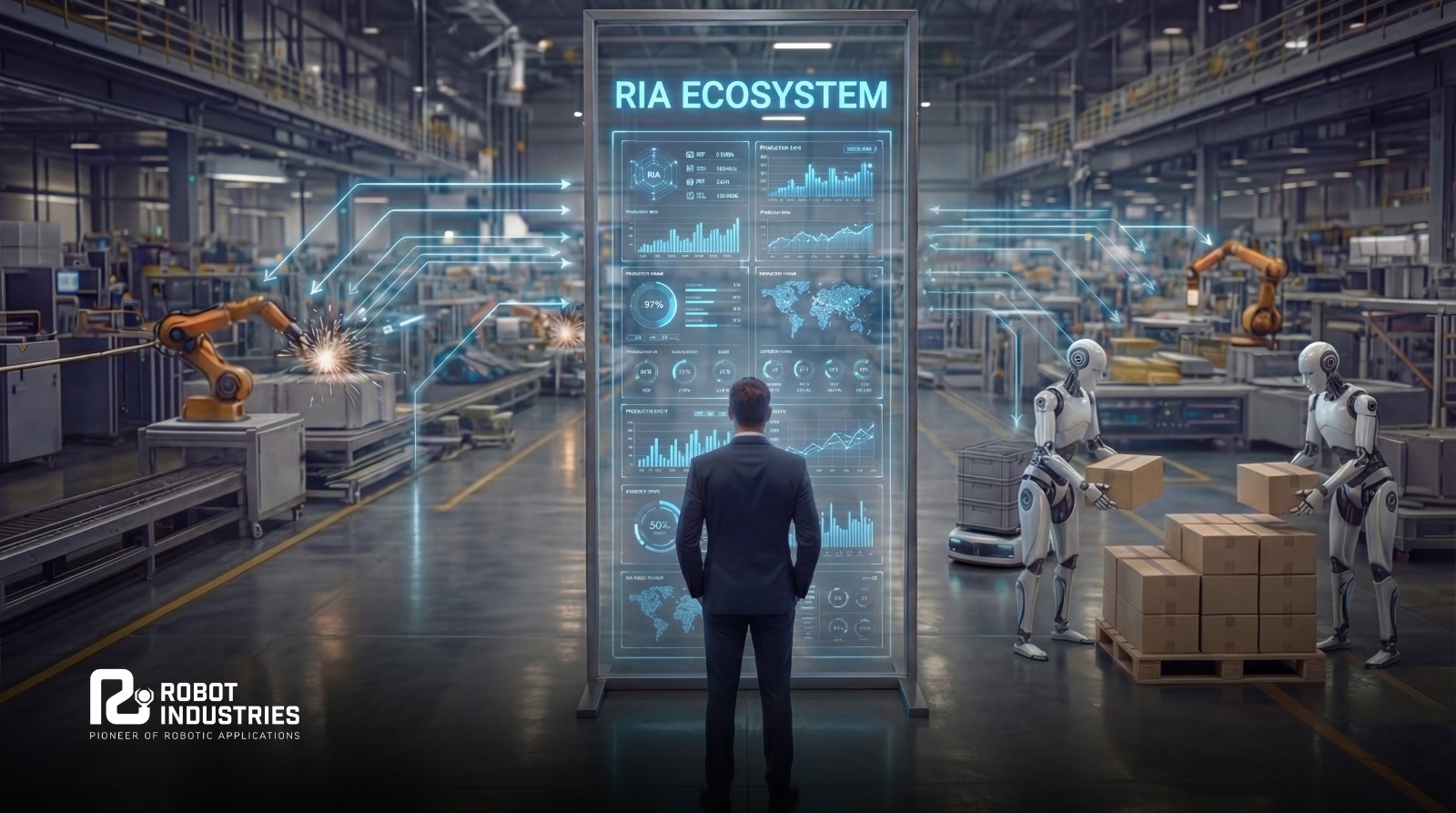
True transformation happens when machines operate not as isolated tools but as synchronized components of an intelligent ecosystem. This shift—from machine intelligence to ecosystem intelligence—is redefining industrial automation. Platforms like the RiA Ecosystem Manager represent the structural foundation of this evolution.
The Limits of Isolated Automation
In traditional setups, each robotic system is programmed to perform specific tasks within defined parameters. While effective, this approach often leads to operational silos:
- Separate interfaces for different robotic brands
- Limited communication between systems
- Static workflows that require manual updates
- Bottlenecks when one unit fails or slows down
Even the most advanced robot cannot compensate for systemic inefficiencies when operating alone.
As factories, logistics hubs, and infrastructure networks scale, this fragmentation becomes increasingly costly. What businesses need is not just smarter robots—but coordinated intelligence across entire fleets.
Ecosystem Thinking: A Structural Shift
Ecosystem-based automation treats robotics as interconnected agents within a shared operational environment. Instead of focusing on programming individual tasks, managers focus on orchestrating missions.
Within an orchestrated ecosystem:
- Robots share performance data in real time
- Tasks are dynamically reassigned based on workload
- Units intervene to prevent workflow disruptions
- System-level performance becomes the primary metric
This structural change dramatically improves resilience and scalability.
Forward-looking organizations such as Robot Industries are leading this shift by designing solutions that prioritize orchestration over isolated programming.
Intelligent Collaboration in Practice
Imagine a production floor where multiple robotic units handle bending, assembly, transport, and inspection. In a conventional system, each machine operates within predefined instructions. If one slows down, the entire sequence risks delay.
In a synchronized ecosystem, however:
- A neighboring unit can absorb overflow tasks
- Task priorities adjust automatically
- Mission sequences adapt to real-time performance
- Managers maintain full visibility from a centralized dashboard
This intelligent collaboration reduces downtime and enhances throughput without requiring manual reprogramming.
The result is not just automation—but adaptive automation.
Integrating Multi-Vendor Environments
Modern industrial environments rarely rely on a single robotics manufacturer. Over time, facilities adopt equipment from different providers, creating diverse technological ecosystems.
Without orchestration, these multi-vendor environments become fragmented and difficult to manage. Integration costs rise. Scalability decreases.
An ecosystem-level orchestration layer unifies heterogeneous fleets under one control framework. Different architectures, hardware types, and AI systems operate cohesively without vendor lock-in.
This approach allows businesses to:
- Expand without infrastructure overhauls
- Integrate emerging technologies seamlessly
- Maintain flexibility in procurement decisions
- Optimize ROI across diverse assets
Governance and Operational Transparency
As autonomy expands, governance becomes essential. Ecosystem intelligence must remain observable, controllable, and accountable.
Orchestration layers provide:
- Transparent action tracking
- Safety standard compliance
- Centralized oversight
- Clear auditability of autonomous decisions
This ensures that increasing automation does not compromise operational control.
The Competitive Advantage of Ecosystem Intelligence
Companies that transition from smart machines to smart ecosystems gain significant advantages:
- Greater operational agility
- Faster adaptation to market changes
- Improved energy efficiency
- Reduced system-wide risk
- Enhanced long-term scalability
In an increasingly competitive global market, these advantages define strategic leadership.
The next phase of industrial transformation will not be driven by more powerful machines alone. It will be defined by intelligent coordination, real-time orchestration, and synchronized ecosystems.
Automation is evolving from isolated brilliance to collective intelligence—and that changes everything.

 Russian
 English
 Arabic
 French
 Spanish
 Portuguese
 Deutsch
 Turkish
 Dutch
Dutch
 Italiano
 Romaian
 Portuguese (Brazil)
 Greek
Greek
